
Disorientation
I am standing on a cliff.
The air is still, the horizon wide, and there - floating impossibly at my eye level - is an airplane.
I’m thinking “That shouldn’t be there…planes belong in the sky above or far away across the horizon.” Yet this one hangs in the air directly in front of me, almost within reach.
I stare at it, puzzled. Why is it here?
Suddenly I am inside the plane. There is no transition, no movement from outside to in. One moment I am observing it, the next I am in it, maybe even blended with it... I’m lying on my back in the plane looking up - at least it seems like ‘up’. I’m not sure.
The aircraft begins spinning. It rotates horizontally, like a body floating on water, turning slowly in a wide circle. I am lying inside the cabin as if gravity has forgotten its job. I’m in a flat spin.
Up and down disappear fully. I cannot tell if I’m gaining altitude or losing it. There is no reference point. No horizon. No sense of direction. Just rotation.
The disorientation grows stronger. I’m not scared, more curious. The usual coordinates that define movement, like forward and back, above and below, have vanished.
Then the plane flips. Suddenly I am looking downward through the aircraft - it’s like the hull of the plane is transparent, but I’m still in it.
Below me is not land, not ocean, not cities - it is a map - and it fills my entire field of vision.
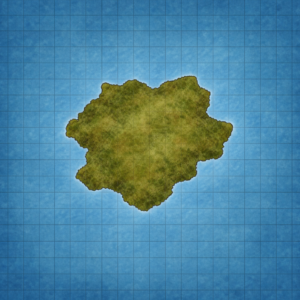
It’s a giant map, covered in longitude and latitude lines like the ones in an atlas. An island is in the center surrounded by blue, I think perhaps it’s Australia, there are no labels or words, I have no idea where it is.
The map is clear and precise. And from my current vantage point it feels completely useless. It’s just a drawing of something that *should* be there and I can’t see anything else - just a 2-D picture of a greenish-brownish irregular shape surrounded by blue overlayed with a grid of thin gray lines.
I stare at this map wondering: Where am I? What is up? What is down? Directions like East and West are irrelevant. Nothing in the map can answer the questions I have.
It’s flat and even though it has color, it is devoid of life and energy.
A final lightning-bolt thought strikes: This is not real and I am no longer navigating by the map modern man created, it just doesn’t make sense anymore…
I wake up and have the sense that I have unplugged from ‘it’, but I’m not quite sure what that means yet - or what that actually looks like in my daily life. I just know that my perspective - and paradigm - radically shifted about who I am, where I am, and what that even means.
I lay in bed and think about how just the night before I was lying in the grass looking up at the night sky with 11 other women on a Maui retreat, listening to a delightful 82yo Astronomer, Harriet Witt, describe how the Polynesians navigated the oceans and islands of Hawaii and the Pacific by the stars, the currents, birds, and their intuition.
As we snuggled together for warmth like a group of small children at story time and listened to Harriet talk about navigating by the stars and examined the language we use to talk about our relationship to the sun, moon, and other planets, I felt something fundamentally shift inside me.
Something that wasn’t intellectual or fixed. Something that felt ancient and wise, deeply disorienting while also comforting…and radical.
While the Greeks first came up with the idea of longitude and latitude in the 3rd century, it wasn’t until the 16th century man put those longitude and latitude lines on the map, and the 18th century before we could actually USE them more accurately. But even with all that precision mapping of latitude and longitude, Harriet pointed out that those lines still don’t tell us anything about the field - the actual environment - itself.
From The Sea Museum
I love this excerpt I found. It perfectly shows how we have come to rely on - and emulate - Cartographers vs. Navigators.
The Cartographer and the Navigator
At the risk of oversimplifying it, let’s just say there are two ways human beings learn to move through the world:
One way belongs to the Cartographer.
The other way belongs to the Navigator.
Cartographers map the world; Navigators move through it.
For most of modern history, we have been trained to live like Cartographers.
A cartographer studies the territory, typically from a distance. They measure it, divide it into coordinates, and create maps that allow others to move through it with precision:
- Longitude and latitude
- Diagnostic categories
- School & career paths
- Treatment plans
- Business strategies
- Marketing funnels
- Five-year plans
Cartographers believe that if the map is detailed enough, the journey can/will be at least somewhat predictable.And for a long time, this approach has worked remarkably well. The modern world was built by cartographers, and there’s so much to be grateful for in these maps and systems - and, so much to question as well.
Despite the number of ‘cartographical’ systems, tools, and ways of thinking we live with these days (just look at your phone or computer you’re reading this on and see the evidence) there is another way of moving through reality. It’s the way of the Navigator.
Navigators do not rely primarily on maps, they rely on presence, awareness, and relationship: it’s analog, and both literally and figuratively, offline.
Ancient Polynesian navigators crossed thousands of miles of open ocean without charts or instruments. They read the stars, the wind, birds, the currents, and the subtle patterns of waves moving across the water.
Their knowledge lived in the body: In sensation, attention, memory.
Where the cartographer asks, “Where am I on the map?”
The navigator asks, “What is the ocean doing right now?”
(This reminds me of my 21yo son sharing the story of traveling in Japan by himself and watching tourists fervently following the blue line on the map on their phone. They never looked up to see what was actually occurring or relying on their own internal sense of direction and spatial awareness while navigating the streets of Tokyo!)
freeworldmaps.net
When the Map Stops Working
Cartographers feel safe when the map is accurate (and their phone is fully charged!)
But when the territory changes faster than the map can be updated, something unsettling happens…the map stops working. We get disoriented and often feel lost, even if we haven’t left our house.
This is the ‘more than a map-glitch moment’ many people are experiencing today. All of us are impacted by most of the following:
- Careers and/or businesses dissolve
- Institutions - even the hallowed ones - are losing authority
- Identities shifting as roles and relationships change
- Parents feel lost when it comes to their children, AI, and technology
- Nervous systems are burned-out and overwhelmed - making it harder to read the map, let alone navigate without it
- Once-trusted sources of news and information, and even leadership, can no longer be trusted (if they ever could!)
- Increased uncertainty about the future - especially when it comes to finances and global fighting
What worked 10 years ago, last month, hell - even yesterday, no longer works.
The coordinates that once provided orientation are beginning to blur, and for someone trained to rely on maps, this can feel like chaos. But for a navigator, it is simply the moment when the journey becomes alive again because navigators were never relying solely on the map in the first place.
They were reading the field.
The Psychology of the Cartographer
Modern psychology often operates through cartography. Diagnostic frameworks map symptoms onto categories. Developmental models describe stages of growth. Personality systems organize identity into types.
These maps can be incredibly helpful, but they also have limits: one of the biggest is that these maps describe patterns that have already been observed - they cannot fully account for what is emerging.
When people undergo deep identity transitions - through trauma healing, psychedelic experiences, spiritual awakenings, or major life changes - the map can suddenly feel inadequate.
The person is no longer where the map says they should be - they are somewhere new.
And often, the only way forward is to lean into (or fall into!) the flat spin, the full disorientation, and reconnect with our innate capacity as humans to be navigators.
As a therapist, I especially feel the tension around managing my own fears and feelings about what’s happening in our country and the world today - that map and ‘Old World’ illusion dissolving - while also holding hope and trusting myself, my clients, and the process.
Human Design and the Navigator’s Compass
Human Design can look like another map: A bodygraph chart filled with symbols, centers, and gates, but its true purpose is not to give you coordinates - it is to help you rediscover your navigation system.
Strategy and Authority are not rules about who you are, they are tools that help you feel the direction of your own movement within the field of life. In other words, they help you navigate.
The Magnetic Monopole, the mechanism we will explore in a future article in this series, functions like the gravitational center of your trajectory.
It pulls your life along a path through time and space.
Your job is not to control the ocean - or the field. Your job is to stay aligned with the current (more about how this works later).
The Return of the Navigator
If the world is indeed moving into a period where centralized systems hold less authority - as many spiritual and cultural observers and systems, including the Human Design framework, suggest - then the skill of navigation will become increasingly important.
People will need to learn how to orient themselves without relying entirely on external maps - especially external ‘authorities’. We have already been seeing this transformation naturally occurring for decades, and more rapidly since 2020.
This does not mean abandoning knowledge - maps & systems still have their place. But maps must be balanced with something older and deeper: The capacity to read the field, sense timing, and trust the signals that arise before the mind can explain them.
In other words:
To become a navigator again.
The Question
The transition from cartographer to navigator is not always comfortable. Cartographers prefer certainty while Navigators accept uncertainty as part of the journey.
When the map no longer matches the territory, and our batteries are running low, one question becomes unavoidable:
Will we keep trying to force the world (or our lives) to match the old outdated map, or will we learn how to sail again using our heart, intuition, and inner compass to read and navigate the stormy seas?
to be continued…
This series of articles will explore what it means to shift from a Cartographer to a Navigator - whether that’s personally, professionally, or even as a therapist, coach or guide who helps others navigate life and change.
We’ll also explore how our Human Design (among other things) can help each of us navigate these profoundly tumultuous currents of change happening right now - all over the planet.
Kris